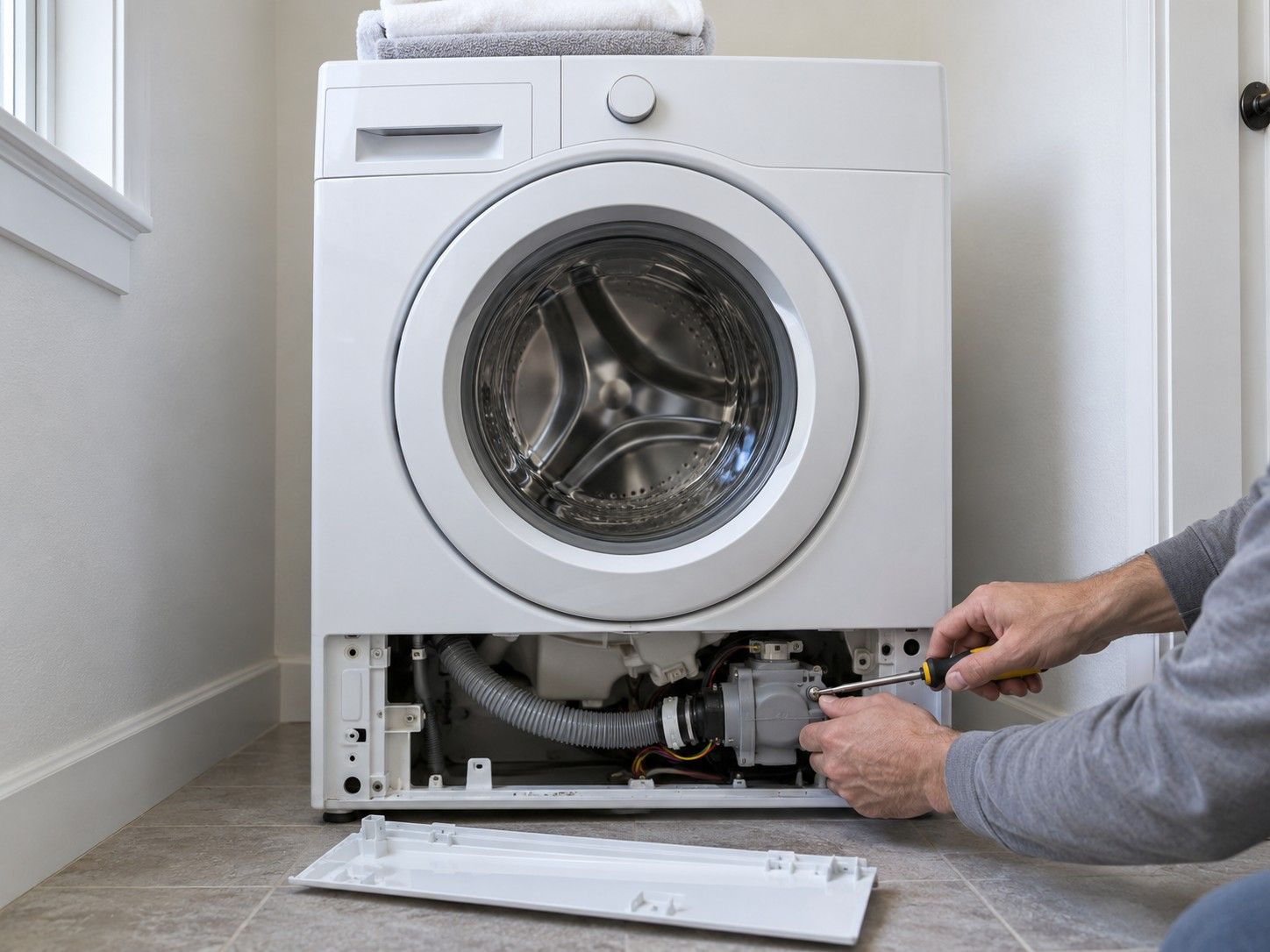
Which problems show up most often?
Four complaints cover most calls: water left in the drum, clothes that come out soaked because the drum never spun, a puddle under the machine, and a washer that lights up but will not start. Each has its own short list of causes, so starting from the symptom saves the technician time and saves you money.
| What you see | Parts usually involved | National range |
|---|---|---|
| Washer not draining | pump filter, drain hose, drain pump | $150–$300 |
| Won't spin the water out | lid switch or door lock, belt, motor coupling, motor | $150–$500 |
| Water on the floor | inlet hoses, door boot, pump or tub seal | $75–$200 |
| Won't start at all | door or lid lock, control board, power | $200–$400 |
| Washer shaking or walking across the floor | unbalanced load, shock absorbers, suspension rods | $150–$450 |
| Banging during spin | worn bearings, loose counterweight | $100–$200 |
Ranges by problem, parts and labor, from Fixr's national washing machine guide, updated January 31, 2025. Your quote depends on the model and your area.
Why front-loaders and top-loaders fail in different places
A front-load washer turns its drum on a horizontal shaft behind a sealed door. The weak points follow from that design: the rubber door boot that holds water in, the electric door lock that must engage before the drum moves, the rear bearings that carry the drum's weight, and a drain pump low at the front with a small trap for coins and hair.
A top-loader sits the tub upright under a lid. Older agitator models wear out drive belts, couplings and transmissions; newer high-efficiency top-loaders without an agitator use a lid lock and suspension rods that sag with age, which is why an unbalanced-load code is so common on them. The water path is the same on both: in through the inlet valve and dispenser, out through the pump and up the drain hose.
- Front-load: door boot seal, door lock, pump filter, bearings and spider arm, odor from residue.
- Top-load: lid switch or lid lock, drive belt or coupling, suspension, agitator dogs on older models.
Prices part by part
When the fault is known, the part decides the bill. Small electrical parts sit near the bottom of the range; anything that means taking the tub apart sits near the top.
| Part replaced | Parts and labor | Job size |
|---|---|---|
| Lid switch | $85–$160 | under an hour on most top-loaders |
| Water inlet valve | $95–$190 | behind the back panel |
| Door lock | $110–$200 | front-loaders; boot clamp comes off |
| Drive belt | $120–$175 | belt-drive models |
| Shock absorbers | $150–$300 | usually replaced as a set |
| Door boot gasket | $230–$300 | two clamps, a careful fit |
| Control board | $250–$400 | price follows the model |
| Drain pump | $300–$400 | bottom access |
| Motor | $300–$500 | direct-drive or belt |
| Drum | $350–$550 | often not worth it on an old machine |
Same Fixr guide. The labor share is typically $50 to $150 an hour.
Is an older washer worth fixing?
Usually yes if it is under ten years old and the repair costs less than half of a comparable new machine. That half-price rule of thumb is the one Fixr uses, and the ten-year line matches the expected life the National Association of Home Builders gives washers in its 2007 study. A drum, transmission or bearing job on a machine past that age is where most people replace instead. The repair-or-replace guide works through the numbers, including running costs.
What can you check before calling?
- Power first. A tripped breaker or a GFCI outlet that has popped looks exactly like a dead control board.
- Both taps fully open. A slow-fill code is the first thing Whirlpool and LG tell owners to rule out, and it is often a half-closed valve or a kinked supply hose.
- Read the code. Write down what the display shows before you unplug anything. The Samsung, LG and Whirlpool pages list what the common codes mean.
- Balance the load. One heavy blanket or a single wet towel can stop a spin. Spread it out and run a drain-and-spin.
- Pump filter on a front-loader. Only if the water is cool: towel down, shallow pan, then open the small door at the bottom front.
Unplug before you open any panel. The control board and motor hold a charge, and a washer that is full of water weighs several hundred pounds. Leave tilting, pulling out and panel removal to the technician.
What to have ready when you call
The model and serial number from the tag (inside the door frame or lid, or on the back), the brand, the machine's age, the symptom in one sentence and any code on the display. That lets the company bring the likely part on the first visit. If the washer is still under the manufacturer's warranty, start with the manufacturer: warranty work goes through its own service network. If you rent, the washer probably belongs to your landlord, who should arrange the repair.
Urgent? A same day appliance repair visit is possible in some areas, depending on the companies that cover your ZIP code.
Questions people ask next
How long does a typical washer fix take once the technician arrives?
Most single-part jobs, such as a lid switch, door lock, drain pump or inlet valve, take one to two hours if the part is on the truck. Bearings, a transmission or a tub seal take longer and often need a second visit because the part has to be ordered for your model.
Will the diagnostic charge be added on top of the repair?
It depends on the company. Fixr notes that the $50 to $100 diagnosis fee is usually waived when you go ahead with the repair. Ask on the phone whether the visit charge is credited, and get the repair price in writing before work starts.
Can I keep using a washer that leaks a little?
Not for long. A small leak at the door seal or a pump hose tends to grow, and water under a washer soaks the subfloor where you cannot see it. Shut the water taps behind the machine between loads until it is looked at.
My washer still works, but it smells musty. Is that a repair?
Usually not. Odor in a front-loader comes from residue in the door boot and the outer tub. Run the cleaning cycle your manual describes, wipe the boot folds, leave the door open between loads and use HE detergent in the measured amount. Call only if the smell comes with a leak or an error code.
Sources
- How much does it cost to repair a washing machine?, Fixr, updated January 31, 2025.
- Study of Life Expectancy of Home Components (PDF, third-party copy), National Association of Home Builders and Bank of America Home Equity, February 2007.
- Error Codes in Front Load Washers, Whirlpool product help, read September 29, 2026.
- LG Washer Error Code Guide, LG Electronics USA, September 3, 2026.
- Washing machine information and error codes, Samsung US support, read September 29, 2026.
- Clothes Washers, ENERGY STAR (EPA), read September 29, 2026.
Reviewed October 1, 2026. Spotted an error? Write to admin@compareappliancerepair.com.