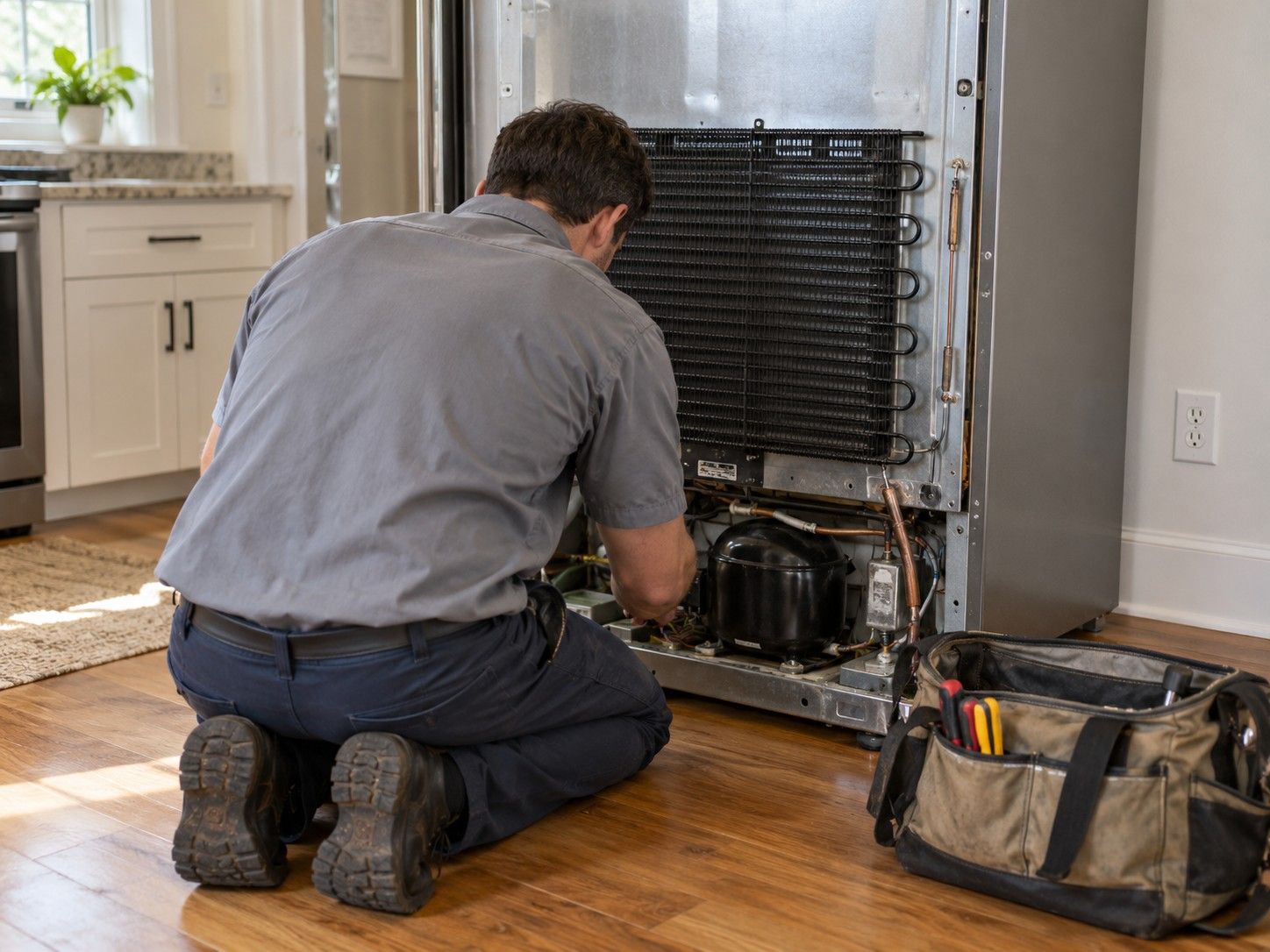
How a refrigerator keeps cold
The compressor pumps refrigerant through a condenser at the bottom or back, where heat leaves the cabinet, and through an evaporator coil hidden behind a panel, usually in the freezer. A fan blows air across that coil into the freezer, and a damper or duct lets some of it into the fresh-food section. Several times a day a heater melts the frost off the coil, and the water runs down a drain to a pan over the compressor, where it evaporates.
That layout explains the most common complaint: a freezer that still freezes while the fresh-food side warms up. The cold is being made, but it is not reaching the fridge section, because a fan, a damper or a frosted coil is in the way.
Symptoms and what they usually cost
| What you notice | Usual causes | National range |
|---|---|---|
| Refrigerator not cooling | evaporator fan, defrost system, condenser coils, start relay | $50–$250 |
| Water on the floor or inside | blocked defrost drain, drain pan, water inlet valve or line | $60–$250 |
| No ice | water valve, frozen fill tube, filter, ice maker module | $350–$500 |
| Too noisy | fan motors, compressor mounts, ice on the fan blade | $200–$300 |
| Not running at all | power, control board, start relay, compressor | $140–$1,200 |
| Refrigerant (freon) leak | sealed-system leak | $200–$300 |
Problem ranges from Fixr's national refrigerator guide, updated August 29, 2025, parts and labor. Its ice maker row reflects work on built-in refrigerator ice makers.
What the parts cost
| Part | Parts and labor |
|---|---|
| Drip pan | $50–$200 |
| Door seal | $60–$100 |
| Condenser coil | $60–$100 |
| Thermostat | $100–$260 |
| Fan | $120–$200 |
| Water dispenser | $170–$500 |
| Evaporator coil, replaced | $200–$300 |
| Compressor | $500–$1,000 |
| Control board | $500–$1,000 |
| Sealed system repair | $800–$1,200 |
Same Fixr guide. A service call there runs $70 to $120 and is normally applied to the first hour of labor; hourly rates are $100 to $250, and most repairs take two hours or less when the part is on hand.
Refrigerator running constantly or making noise
A refrigerator running constantly is usually losing its fight with heat: dusty condenser coils, a worn door gasket, a door that does not close on its own, a frosted evaporator coil or a condenser fan that has stopped. Long run times are normal for a while after the doors have been open or a load of warm groceries goes in. A refrigerator making noise has a short list of sources: fan blades touching ice or debris, a fan motor wearing out, the compressor's mounts, or the water valve while the ice maker fills. Fixr puts noise repairs at $200 to $300.
Refrigerator compressor and sealed-system work
A household refrigerator counts as a small appliance under the EPA's refrigerant rules. Anyone who could open its refrigerant circuit, to replace a compressor or fix a leak, must hold Type I technician certification under Section 608, unless the refrigerant is one the EPA has exempted: isobutane (R-600a) and R-441A in household refrigerators and freezers. The refrigerant type is normally printed on the model label. A refrigerator compressor replacement is where the bill jumps and where the repair-or-replace question gets serious. Ask whether the quote includes finding the leak, not only recharging.
Repair or replace an older fridge?
The National Association of Home Builders puts a standard refrigerator's expected life at 13 years. Fixr suggests that any appliance more than ten years old may be better replaced than repaired, and never to spend more than half the price of a new model on a repair. Running cost adds to the case: ENERGY STAR says a refrigerator over 15 years old could be costing about $95 a year more to run, and that an old fridge uses about 20 percent more energy than an ENERGY STAR certified one. For reference, the EIA puts the average cost of running a home's main refrigerator at about $87 a year (2020 data). Federal efficiency standards have applied since September 15, 2014, and stricter ones take effect for units made from January 31, 2029 or 2030, depending on the product class.
What to check first
- Power and settings. Check the outlet, the control setting and whether a demo or showroom mode is on; some models cool nothing in that mode.
- Airflow inside. Food pressed against the vents at the back of the freezer or fridge blocks the cold air path.
- Condenser coils. Unplug the fridge and vacuum the coils underneath or at the back; dust makes the compressor run long and still fall short.
- Listen at the freezer. With the door switch pressed, you should hear the evaporator fan. Silence, or a scraping sound, points at the fan or ice around it.
- Door gasket. Close the door on a dollar bill in several places; it should resist when pulled.
A refrigerator repairman will ask for the model and serial number from the rating label; the owner's manual shows where it is on your model. If the food is already warming, keep the doors shut and consider a same day appliance repair visit, which depends on the companies covering your ZIP code. Brand-specific issues, such as ice makers in the doors of some Samsung models or LG's linear compressors, are covered on the Samsung and LG pages.
Questions people ask next
Is it worth fixing a refrigerator that is ten years old?
For a fan, thermostat, defrost part, gasket or water valve, usually yes. For a compressor or a sealed-system leak, often not: Fixr puts those at $500 to $1,200 against $1,000 to $3,000 for a new fridge, and a standard refrigerator is expected to last about 13 years.
How cold should a refrigerator be?
At or below 40°F in the fresh-food section and 0°F in the freezer, the food-safety targets the FDA gives. Keep an appliance thermometer in each compartment, as the FDA advises; the numbers on the control are settings, not degrees.
How long does food last if the fridge stops?
The FDA says an unopened refrigerator keeps food cold for about 4 hours, and that refrigerated perishables such as meat, poultry, seafood, milk, eggs and leftovers should be discarded once they have been above 40°F for 4 hours or more. A fridge that is slowly warming is worth moving on the same day.
Sources
- How much does it cost to repair a refrigerator?, Fixr, updated August 29, 2025.
- Study of Life Expectancy of Home Components (PDF, third-party copy), National Association of Home Builders and Bank of America Home Equity, February 2007.
- Refrigerators, ENERGY STAR (EPA), read September 29, 2026.
- Electricity use in homes, U.S. Energy Information Administration, RECS 2020 data, read September 29, 2026.
- Refrigeration Products, U.S. Department of Energy, read September 29, 2026.
- 10 CFR 430.32, Energy and water conservation standards and their compliance dates, eCFR, current as of September 22, 2026.
- Food and Water Safety During Power Outages and Floods, U.S. Food and Drug Administration, read September 29, 2026.
- Keep Your Food Safe During Emergencies, USDA Food Safety and Inspection Service, last updated August 7, 2013.
- Section 608 Technician Certification, U.S. Environmental Protection Agency, read September 29, 2026.
- 40 CFR 82.152, Definitions (small appliance), eCFR, read September 29, 2026.
- 40 CFR 82.161, Technician certification, eCFR, read September 29, 2026.
- Stationary refrigeration: prohibition on venting refrigerants, U.S. Environmental Protection Agency, read September 29, 2026.
Reviewed October 1, 2026. Spotted an error? Write to admin@compareappliancerepair.com.