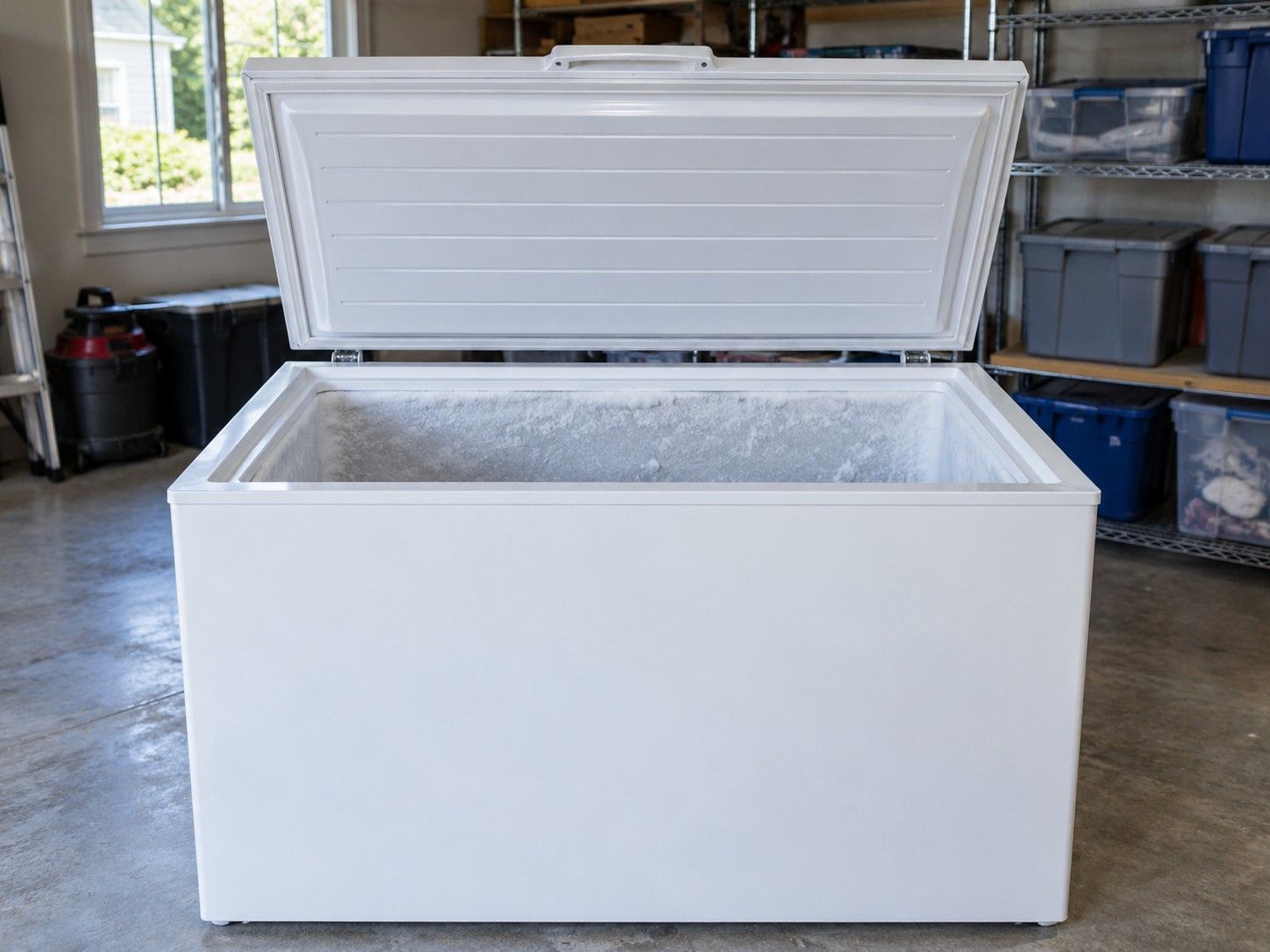
Chest and upright freezers are built differently
Most chest freezers are manual defrost. The cooling tubing runs inside the inner walls, so frost forms right on the walls and has to be melted off by hand from time to time. There is no fan and no defrost heater, which leaves fewer parts to fail: the compressor, its start relay and overload, the thermostat and the lid gasket.
Many upright freezers defrost themselves automatically. They hide an evaporator coil behind a back panel, blow air across it with a fan, and melt its frost on a schedule with a defrost heater, a defrost thermostat and a timer or control. The meltwater drains to a pan under the cabinet. More convenience means more parts, and the defrost system is where many upright problems start.
Symptoms and national price ranges
| Problem | Usual cause | National range |
|---|---|---|
| Freezer not freezing (not cold enough) | condenser, fan, relay, thermostat, refrigerant | $50–$500 |
| Runs all the time, or a freezer making noise | dirty condenser, door seal, defrost failure | $75–$300 |
| Does not defrost (heavy frost buildup) | defrost heater, thermostat, timer | $50–$250 |
| Starts and stops every few minutes | start relay, overload, compressor | $150–$650 |
| Water on the floor | blocked defrost drain, drain pan | $75–$650 |
| Does not run at all | power, control, compressor | $250–$650 |
Fixr national freezer guide, updated August 29, 2025, parts and labor.
Parts that are replaced most often
| Part | Parts and labor |
|---|---|
| Defrost sensor | $75–$200 |
| Thermostat | $75–$300 |
| Start relay | $75–$300 |
| Fan | $100–$300 |
| Door or lid seal | $150–$500 |
| Compressor | $250–$650 |
| Control board | $300–$650 |
Same Fixr guide. It lists a service call at $45 to $150 in most areas, plus a possible diagnostic fee of $50 to $100.
Repair, or let it go?
Fixr's rule is to repair a freezer that is under ten years old when the repair costs less than half of a new one, and it puts replacement at $600 to $1,150. The National Association of Home Builders gave freezers an expected life of 11 years. Running cost is modest: the Energy Information Administration puts a separate freezer at about $74 a year to operate on average (2020 survey data). ENERGY STAR certified freezers are at least 10 percent more efficient than the federal minimum, and federal standards for freezers have applied since September 15, 2014. A sealed-system repair on an old freezer rarely pays; a relay, thermostat or seal usually does.
Protect the food while you wait
- Keep the lid or door closed. The USDA says a full freezer holds its temperature for about 48 hours without power (24 hours if half full) as long as the door stays shut.
- Put a thermometer inside so you know the actual temperature rather than guessing from how the food feels.
- Move food if you have room elsewhere, starting with meat and fish.
- Clear the space around the cabinet so it can shed heat: a freezer boxed in by storage runs hot.
What to say when you call
Say whether it is a chest or upright, manual defrost or automatic-defrost, where it stands (house, basement, garage), the temperature inside, and what you hear: silence, a click every few minutes, or a compressor that never stops. The model number is usually on a label inside the lid or on the side wall. Urgent because the food is at risk? A same day appliance repair visit depends on the companies that cover your ZIP code.
Questions people ask next
The sides of my chest freezer feel warm. Is something wrong?
Usually not. Many chest freezers run the condenser tubing inside the outer walls, so the cabinet sides get warm while the compressor runs. That is how the freezer gets rid of heat. Warm sides together with soft food inside is a different story and worth a call.
Can a freezer live in the garage?
Many can, but check the manual for the room temperature range the model is built for. An unheated garage in winter or a hot one in summer can push a freezer outside that range, and some models are sold specifically as garage-ready for that reason.
Who is allowed to fix a refrigerant leak?
Under the EPA rules made under the Clean Air Act, work that opens the sealed refrigerant system has to be done by a technician with Section 608 Type I certification, unless the freezer uses a refrigerant EPA has exempted, such as isobutane (R-600a). Ask about it when a sealed-system repair is proposed.
Sources
- How much does it cost to repair a freezer?, Fixr, updated August 29, 2025.
- Study of Life Expectancy of Home Components (PDF, third-party copy), National Association of Home Builders and Bank of America Home Equity, February 2007.
- Freezers, ENERGY STAR (EPA), read September 29, 2026.
- Electricity use in homes, U.S. Energy Information Administration, RECS 2020 data, read September 29, 2026.
- 10 CFR 430.32, Energy and water conservation standards and their compliance dates, eCFR, current as of September 22, 2026.
- Section 608 Technician Certification, U.S. Environmental Protection Agency, read September 29, 2026.
- Stationary refrigeration: prohibition on venting refrigerants, U.S. Environmental Protection Agency, read September 29, 2026.
- Keep Your Food Safe During Emergencies, USDA Food Safety and Inspection Service, last updated August 7, 2013.
Reviewed October 1, 2026. Spotted an error? Write to admin@compareappliancerepair.com.