How a dryer actually dries
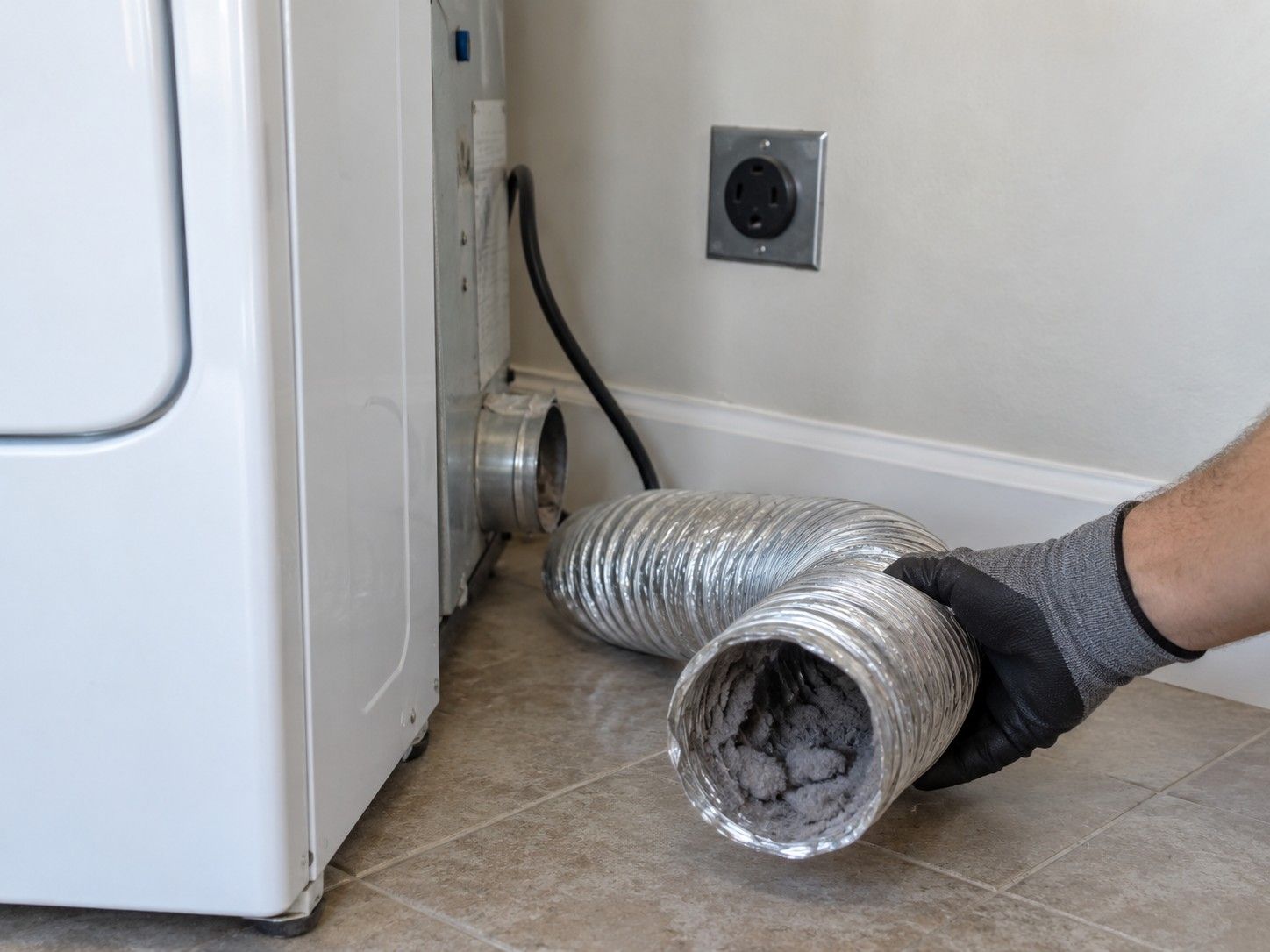
A blower pulls room air past the heat source (an electric element or a gas burner), through the tumbling clothes, out through the lint screen and down the exhaust duct to a hood on an outside wall. Moisture leaves as warm, wet air. Take away the heat and the clothes tumble cold; take away the airflow and they tumble hot and damp; take away the drum drive and nothing moves. That is why the first question a technician asks is which of those three you are seeing.
Symptoms and the parts behind them
| What you notice | Usual suspects | National range |
|---|---|---|
| Dryer not heating | thermal fuse, element, thermostats, igniter, gas valve coils | $100–$350 |
| Hot, but loads stay damp | lint in the vent run, crushed duct, stuck wall flap | often a vent job, not a part |
| Nothing happens at start | door switch, thermal fuse, start switch, motor | $50–$450 |
| Motor runs, drum still | belt, idler pulley, rollers | $100–$450 |
| Dryer making noise: squeal, thump or scrape | rollers, glides, idler, bearing | $75–$450 |
Problem ranges from Fixr's national dryer guide, updated January 31, 2025, parts and labor. A dryer squeaking at every turn is usually the rollers or idler, the cheaper end of the noise range.
Electric and gas dryers fail differently
An electric dryer runs its motor on 120 volts and its heating element on 240 volts. If one half of the double breaker trips, the drum can still turn while the element stays cold, which is why "runs but no heat" on an electric model sends people to the breaker panel first. Elements themselves burn through, and the thermostats and thermal fuse that protect them open when the dryer overheats.
A gas dryer lights a burner with a hot-surface igniter. A flame sensor tells the valve to keep gas flowing, and two small solenoid coils on the valve open it. When those coils weaken, the dryer heats for a while and then stops, a pattern owners describe as "it works sometimes." Fixr lists igniter replacement at $100 to $250 and valve coils at $150 to $300.
Prices for the parts that fail
| Part replaced | Parts and labor |
|---|---|
| Door switch | $50–$150 |
| Drum rollers | $100–$150 |
| Thermostat | $100–$260 |
| Igniter (gas) | $100–$250 |
| Belt | $150–$250 |
| Gas valve coils | $150–$300 |
| Heating element (electric) | $150–$350 |
| Motor | $250–$450 |
| Drum | $300–$450 |
Fixr's replacement-part ranges, same guide. Labor there runs about $50 to $100 an hour, and a visit to diagnose costs $50 to $80.
When a new dryer makes more sense
Fixr compares a typical $150 repair with $600 to $1,500 for a replacement. A drum or motor job on a dryer that is 12 years old or more is where the comparison usually tips toward buying. Running cost also matters: ENERGY STAR says certified heat pump dryers use around 70 percent less energy than conventional models. Federal efficiency standards for dryers made from March 1, 2028 are already on the books, per the Department of Energy. The repair-or-replace guide lays out the arithmetic.
Safe checks before you call
- Clean the lint screen and look into the slot it slides into.
- Go outside and watch the wall hood while the dryer runs. The flap should open and you should feel strong, warm airflow.
- Check both halves of the breaker on an electric dryer, and that the gas valve behind a gas dryer is open.
- Note the sounds and any code, and whether the drum turns by hand with the dryer unplugged.
If you smell gas, do not start the dryer, flip switches or use a phone nearby. Leave the house and call 911 or the gas company's emergency line from a neighbor's house or somewhere well away from the smell. A burning smell with an electric dryer means unplug it and do not run it again until it is checked.
Need it fixed quickly? A same day appliance repair visit depends on which companies cover your ZIP code. Have the model number from the tag inside the door opening ready when you call.
Questions people ask next
Gas or electric: does it change who can fix it?
The drum, belt, rollers and motor are the same kind of work on both. The heat source is not: a gas dryer has an igniter, a flame sensor and gas valve coils, and anyone disconnecting or reconnecting the gas line should know gas work. Say which type you have when you call.
How long do dryers usually last?
The National Association of Home Builders put both gas and electric dryers at about 13 years in its 2007 study. Fixr says most are designed for 8 to 12 years and that many run 15 or more when the vent is kept clean.
Is a squeak or thump worth a service call?
Yes, before it becomes a no-tumble call. Squeaks usually come from drum rollers, glides or the idler pulley, and thumps from a flat spot on a roller or a loose drum. Those parts wear gradually, and replacing them early is a smaller job than replacing them after a belt breaks.
Sources
- How much does it cost to repair a dryer?, Fixr, updated January 31, 2025.
- Study of Life Expectancy of Home Components (PDF, third-party copy), National Association of Home Builders and Bank of America Home Equity, February 2007.
- Clothes Dryers, ENERGY STAR (EPA), read September 29, 2026.
- Consumer Clothes Dryers, U.S. Department of Energy, read September 29, 2026.
- Emergency response: what to do if you suspect a gas leak, U.S. Pipeline and Hazardous Materials Safety Administration, read September 29, 2026.
Reviewed October 1, 2026. Spotted an error? Write to admin@compareappliancerepair.com.