Hot but damp means airflow
A dryer dries by moving air, not by heat alone. A wet load has to shed a lot of water as vapor, and the blower has to push that warm, wet air through the lint screen, the duct and out of the house. When the path narrows, the air slows, the drum stays humid, and the heating element or burner cycles off on its thermostat because the dryer is overheating instead of drying. The clothes come out hot and damp, and the dryer takes too long to dry every load.
If the drum is cold instead of hot, this is not an airflow problem; go to the page on a dryer not heating.
Dryer vent clogged? Find the restriction
- Lint screen and its slot. Clean the screen and hold it under the tap. Water that beads on the mesh means dryer-sheet film is blocking it; scrub it with warm, soapy water. Shine a light into the slot for lint that got past.
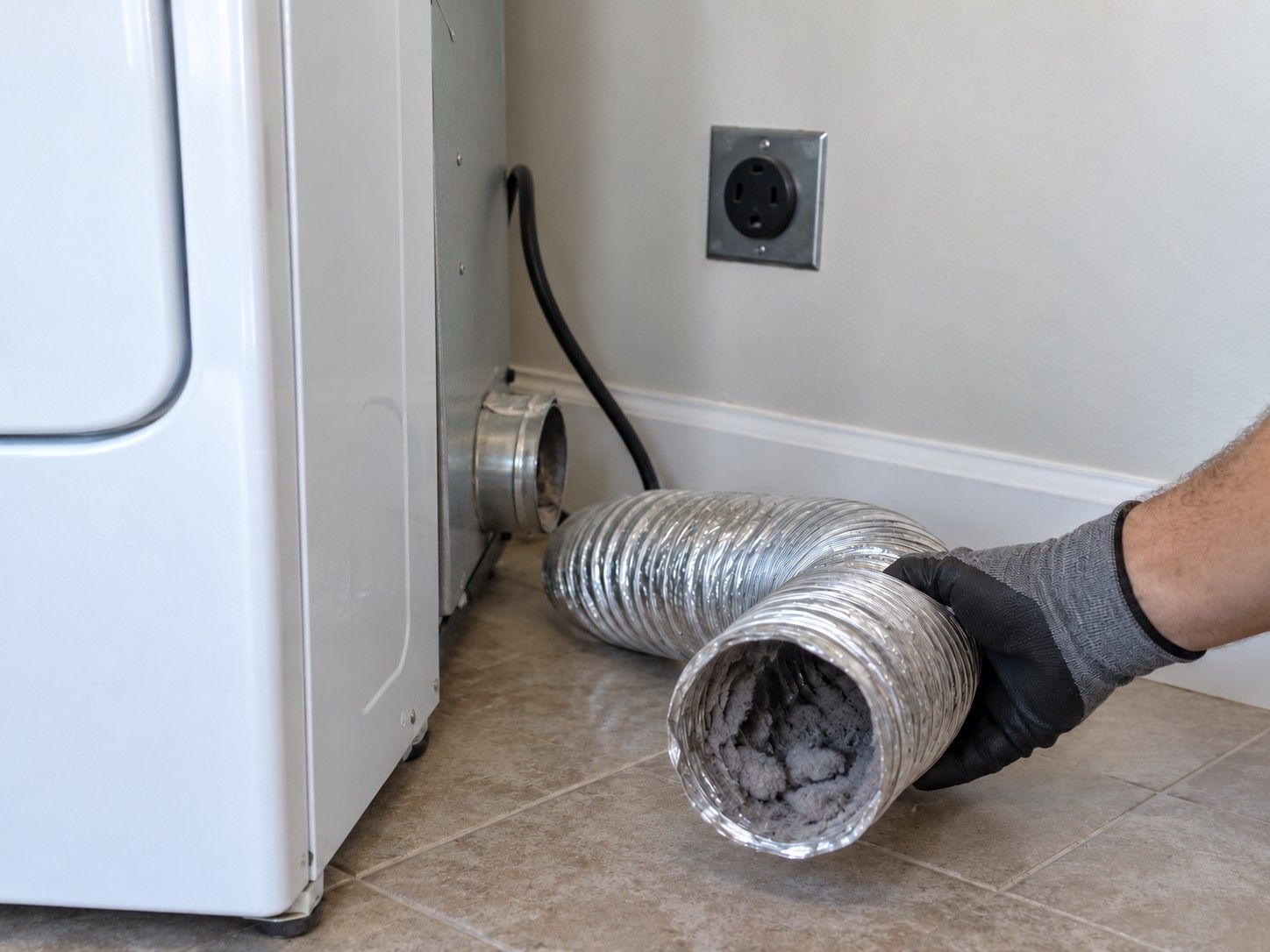
- The duct behind the dryer. Pull the dryer out and look at the transition duct. It should be a short, smooth run with no crushed sections. Dryers pushed tight against the wall flatten it.
- The flap outside. Run the dryer and go outside. The hood flap should open fully and you should feel strong, warm air. A weak puff, lint around the opening or a flap stuck shut points into the duct.
- The run through the wall or roof. Long runs, many elbows and roof terminations collect lint quickly. Birds and wasps also nest in hoods without a working damper.
- Moisture sensor. On sensor-dry cycles, a film on the metal sensor bars inside the drum can end the cycle early. Wipe them, then compare a sensor cycle with a timed cycle.
What the building code allows
| Rule | 2021 International Residential Code, M1502 |
|---|---|
| Transition duct (behind the dryer) | one listed length, no more than 8 feet, not concealed in construction |
| Exhaust duct length | 35 feet from the transition duct to the outside terminal |
| 4-inch mitered 90° elbow | counts as 5 feet of that length |
| 4-inch mitered 45° elbow | counts as 2 feet 6 inches |
| Dryer maker's own table | takes precedence when the make and model are known |
| Runs longer than 35 feet (equivalent) | must carry a permanent label near the duct connection |
| Booster fans | not allowed in dryer exhaust |
IRC 2021 sections M1502.4.3 to M1502.4.7 as adopted in New Jersey; your state or city may use a different edition or local amendments.
A run with three 90-degree elbows has already used 15 of its 35 feet before any straight duct is counted, which is why dryers in interior laundry rooms so often dry slowly.
Why this is a safety issue, not just a slow cycle
The National Fire Protection Association estimated about 15,970 home fires a year involving clothes dryers or washing machines in 2010 to 2014, and 92 percent of them involved dryers. Failure to clean was the factor cited most often, in 31 percent of those fires, and dust, fiber and lint was the item first ignited more often than anything else. A dryer that takes two cycles to dry a load is often a dryer running hot against lint.
Stop using the dryer if you smell scorching, see lint smoking at the hood, or the top of the cabinet is too hot to touch. Unplug it (and shut the gas valve on a gas dryer) until the vent is cleared and the dryer is checked.
Who fixes what, and what it costs
Clearing a vent run is often a job for a dryer vent cleaning service. An appliance technician handles the dryer itself: a blower wheel clogged with lint, a thermal fuse or thermostat that failed from the heat, a crushed transition duct replaced with rigid or semi-rigid metal. Fixr lists vent work on a dryer at $75 to $150 and a thermostat at $100 to $260.
Details to give when you call
Say that the dryer heats but does not dry, how long a load now takes, where the vent exits (wall, roof, or a long run through a crawlspace), and whether the lint screen and flap checks turned up anything. Give the model number from the tag inside the door opening.
Questions people ask next
Is the foil or plastic accordion duct behind my dryer a problem?
The flexible piece behind the dryer is the transition duct, and the International Residential Code allows it only if it is a single, listed length of no more than 8 feet that is not hidden inside a wall. Plastic or vinyl accordion duct is not what the code means; it sags, traps lint and crushes easily.
How long can a dryer vent run be?
The 2021 International Residential Code sets 35 feet for the exhaust duct, measured from the transition duct to the outside terminal, and subtracts length for each fitting: 5 feet for a 4-inch mitered 90-degree elbow, 2.5 feet for a 45. If the dryer maker publishes its own length table, that table applies instead.
Should I hire a vent cleaner or an appliance repair company?
If the dryer heats fine and the problem is lint in a long run through the wall or roof, a dryer vent cleaning service is the right trade. If the dryer also overheats, trips its thermal fuse or has a failed thermostat, an appliance technician fixes the dryer and can tell you whether the vent needs separate cleaning.
Sources
- International Residential Code 2021, Section M1502 Clothes Dryer Exhaust (as adopted in New Jersey), International Code Council, via UpCodes, read September 29, 2026.
- Home Fires Involving Clothes Dryers and Washing Machines, National Fire Protection Association, March 2017.
- How much does it cost to repair a dryer?, Fixr, updated January 31, 2025.
Reviewed October 1, 2026. Spotted an error? Write to admin@compareappliancerepair.com.