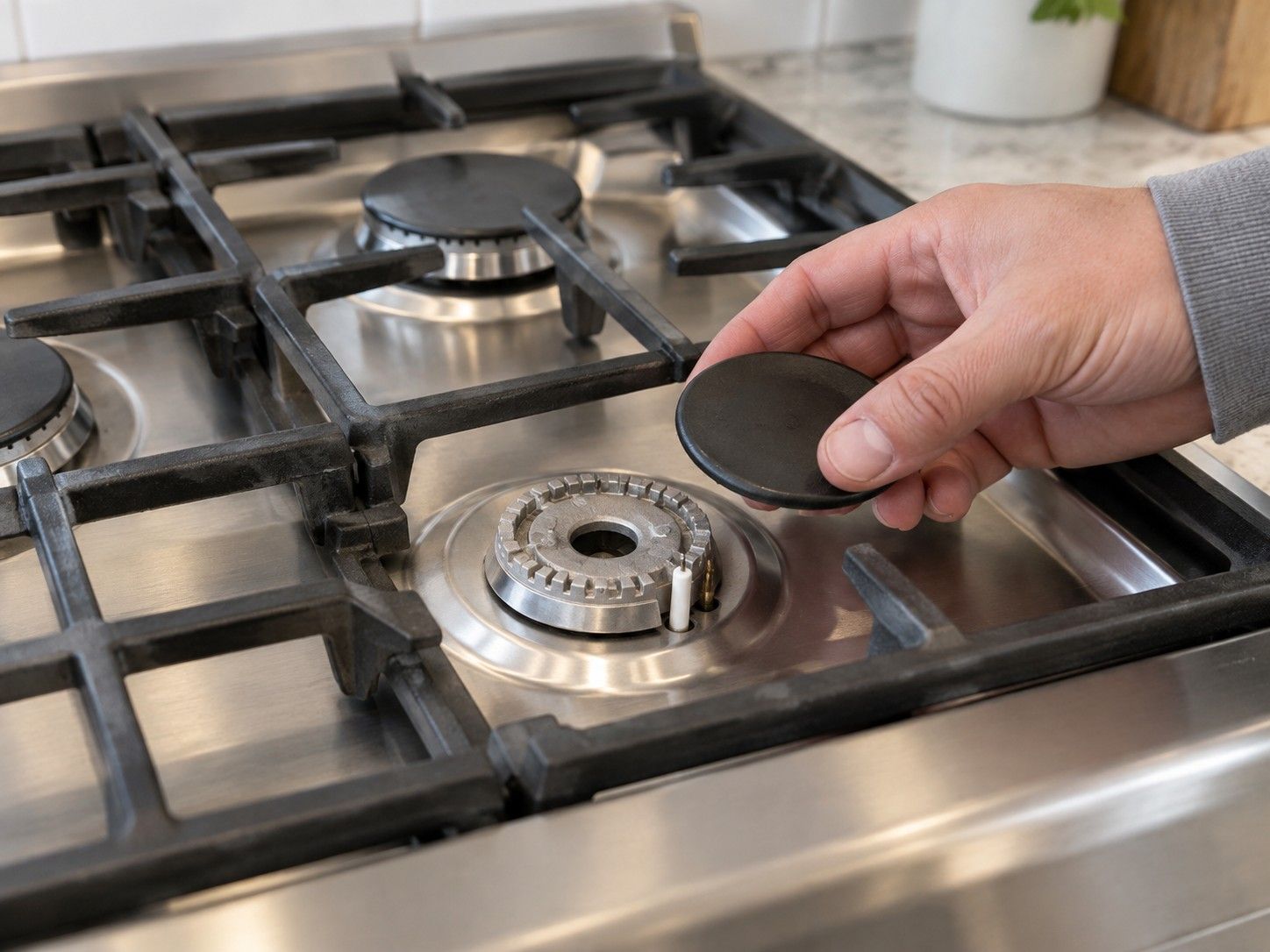
How a sealed burner lights
Turning a knob to the light position closes a small switch behind it. That switch tells a spark module to send high voltage to the spark igniter, a ceramic-insulated electrode next to each burner, which snaps a spark across to the burner head. At the same time the valve lets gas up through a small orifice into the burner head, where it mixes with air and comes out of the ring of ports. The spark lights the gas at the ports nearest the electrode, and the cap on top spreads the flame evenly around. If any link in that chain is off, you get noise without flame, or flame without noise.
Clicking, but no flame
- Reseat the cap. Lift it, wipe it, and set it back flat and centered. A cap that sits crooked blocks the ports next to the electrode.
- Let it dry. A gas burner won't light after cleaning more often than at any other time. After a boil-over or a wash, water in the burner head keeps the gas from lighting and can short the spark. Leave the cap off for a few hours, or dry it with a hair dryer on low.
- Clear the ports. Use a straightened paper clip or a needle, not a toothpick that can snap off inside. Brush crumbs out of the gap between electrode and head.
- Look at the spark. In a dim room, turn the knob and watch the electrode. A weak, orange or missing spark on one burner, while the others spark blue, points to a cracked electrode or its wire.
No clicking at all
If none of the burners click, the spark module is not getting power or has failed. Check that the range is plugged in and the breaker is on: gas cooktops still need 120 volts for the spark. If one burner never clicks but the others do, its switch or electrode wire is the likely fault. Fixr lists an igniter that will not click at $150 to $300 to repair.
Clicking that won't stop
Gas stove clicking that continues with the knob at off is usually moisture in a switch from a spill. Turn the power off at the breaker for a few hours to let it dry. If it clicks again once power is back, one of the switches behind the knobs has failed and needs replacing. Fixr's range for clicking when off is $75 to $300.
Typical costs
| Problem or repair | Parts and labor |
|---|---|
| Knob won't turn the burner on | $75–$150 |
| Clicking when off | $75–$300 |
| Weak burner flame | $75–$400 |
| Burner replacement | $75–$250 |
| Burner won't light | $100–$400 |
| Valve replacement | $100–$350 |
| Igniter replacement | $150–$400 |
| Gas leak repair | $200–$750 |
Fixr national gas stove guide, updated January 31, 2025. Labor there runs $50 to $100 an hour.
When to stop and call right away
Gas smell with the burners off, or a smell that lingers after a failed light, means gas is escaping. Turn the knob off if you can do it safely, do not operate switches, strike a match or use a phone inside, and leave. Call 911 from a neighbor's house or well away from yours.
Call a technician rather than keep trying if the spark is fine and the burner still will not light, if a flame lights but goes out, or if one burner's flame stays yellow after cleaning. Give the model number from the tag (on many ranges it is on the frame behind the storage drawer or under the cooktop) and say whether the problem is one burner or all of them.
Questions people ask next
All the burners click when I turn only one knob. Is that normal?
Yes. On most gas cooktops every electrode sparks together whenever any burner switch is turned to light, because they share one spark module. Clicking that continues after the knob is back at off is not normal: that is usually moisture at a switch or a switch that has failed.
Can I light the burner with a match while it is broken?
Many manuals describe lighting a surface burner with a match during a power outage, and on those models it is safe for a burner whose spark system has failed. Check your manual first. Never do it if you smell gas before lighting, and never try it on the oven burner.
Why is the flame yellow and lazy instead of blue?
A yellow, floppy flame usually means the burner cap is not seated, the ports are partly blocked, or the air-to-gas mix is off. Clean and reseat the cap first. If it stays yellow, have it checked; incomplete burning produces soot and carbon monoxide.
Sources
- How much does it cost to repair a gas stove?, Fixr, updated January 31, 2025.
- Emergency response: what to do if you suspect a gas leak, U.S. Pipeline and Hazardous Materials Safety Administration, read September 29, 2026.
Reviewed October 1, 2026. Spotted an error? Write to admin@compareappliancerepair.com.